
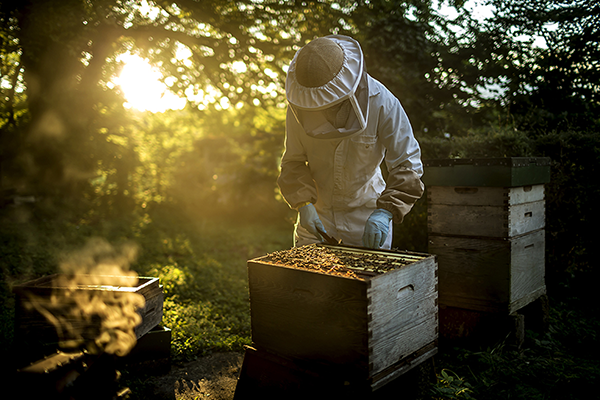
One honey may be almost transparent and very delicate. Another may have a deep amber color, a pronounced aroma and a flavor that lingers on the palate. The origin of honey and its properties are closely connected. Some honeys crystallize quickly, while others remain liquid for many months. These differences are not accidental.
Natural honey is produced in a specific place and at a specific time. Its character is influenced by the plants available to bees, the weather during the flowering period, the terrain, conditions inside the hive, and the way the honey is harvested, stored and prepared for sale.
In the world of wine, the term “terroir” is used frequently. It describes the relationship between a product and its place of origin: the climate, soil, topography and local production methods. The same idea is applied to coffee, tea, cocoa and olive oil. Honey can be viewed in the same way.
The relationship between honey origin and its properties mainly concerns sensory and physicochemical characteristics. These include taste, aroma, color, consistency, crystallization rate, water content, sugar ratios and the presence of selected compounds that occur naturally in the raw material.
This does not mean that geographical origin automatically determines the quality of every product. Rather, it means that honey records the environment from which it comes and should not be treated as a completely uniform food category.
Terroir can be understood most simply as the combination of environmental conditions and production methods that gives a product its recognizable character. In the case of honey, the plants available to bees are particularly important.
Bees collect nectar from flowers located within their flight range. When many plant species bloom at the same time in the surrounding area, the resulting honey may have a complex, multifloral character. When one particular plant species dominates during a given period, the proportions of raw materials brought to the hive will be different.
However, the name of a region on the label is only the beginning of the story. Even within the same area, valleys, forests, meadows, fields and mountain zones may differ in vegetation. Two apiaries located only a dozen or so kilometers apart may have access to slightly different nectar sources.
The time of harvest is also important. Plants flower at different times, so honey collected in spring may have a different profile from honey produced in late summer. Honey terroir is therefore not merely a point on a map. It also includes the season and the conditions of a particular year.
Nectar provides bees mainly with water and sugars. It also contains smaller quantities of other plant-derived substances. Their profile may vary depending on the plant species, growing conditions and stage of flowering.
After bees process the nectar, some of these differences remain noticeable in the finished honey. They may affect its aroma, color, acidity, sugar ratios and the profile of compounds present in low concentrations.
For this reason, laboratories do not examine only the basic sugar content. They may also analyze pollen grains, volatile substances, minerals, organic acids and selected phenolic compounds.
There is no single, simple component that can always and infallibly identify where a honey comes from. A natural product is a complex mixture, and its profile is shaped by many factors.
It can be said that plants leave distinctive traces in honey. Reading those traces correctly usually requires a combination of several analytical methods.
Honey is not simply nectar poured into a honeycomb. Once the raw material has been collected, a multistage transformation process begins.
Bees enrich the collected material with their own enzymes, pass it between one another and gradually reduce its water content. They then place it in honeycomb cells, where it continues to mature. The wing movements of worker bees support air circulation inside the hive and help water evaporate.
When the honey reaches the appropriate level of maturity, the bees seal the cells with a thin layer of wax. The final product is therefore the result of both plant processes and the work of the entire bee colony.
Conditions inside the hive, colony strength, water availability, and the duration and intensity of nectar flow may all be relevant. Bees are not merely a means of transport between flowers and the honeycomb. They actively help create the honey’s final form.
The same region may produce honey with a slightly different character from one year to the next. Weather variability is the main reason.
A warm spring may accelerate flowering. Late frosts may shorten or limit the availability of some plants. Prolonged rainfall makes it difficult for bees to fly, while drought may affect the amount of nectar produced by plants.
Average temperature is not the only important factor. Daily temperature fluctuations, humidity, sunlight, wind and the distribution of rainfall also matter. All of these elements affect plants and indirectly influence the work of bees.
Natural variation is not necessarily a flaw. In agricultural and bee products, it may show that the raw material was produced in a real environment rather than according to an industrial formula designed to guarantee an identical flavor in every batch.
Of course, this variation must remain within food quality and safety requirements. It does not mean that anything is acceptable. It does, however, help explain why natural batches may differ slightly in color, aroma or consistency.
Bees do not obtain ingredients directly from the ground. The influence of soil on honey is therefore indirect and occurs mainly through plants.
The type of substrate, water availability, soil pH and local conditions affect which species can grow in a particular place. They also influence plant health and the duration of flowering.
Soil helps shape local vegetation, while vegetation determines the nectar and pollen sources available to bees. In this sense, soil is one element of terroir. It should not, however, be described as a simple ingredient that can later be directly “tasted” in honey.
The mineral profile of honey may be one of the parameters used when analyzing origin. On its own, however, it is usually insufficient to identify one specific location with certainty.
Honey can range in color from almost clear through straw-colored and golden to amber and brown. Its color depends, among other things, on botanical source, naturally occurring pigments, mineral composition and storage conditions.
Color may provide a useful clue, but it should not be used as an independent measure of quality. It cannot automatically be assumed that dark honey is always better, more valuable or more suitable for every consumer.
Light honeys are often valued for their delicacy and subtle aroma. Darker honeys may have a heavier and more pronounced profile. These are primarily sensory differences.
Color may also change over time and under the influence of temperature. Honey should therefore be assessed together with information about its variety, age, storage conditions and quality-control results.
Aroma – A Fleeting Trace of the Landscape
The scent of honey is created by volatile aromatic compounds. Their combination may evoke flowers, herbs, fruit, resin, wood, caramel or spices.
Aroma is one of the most delicate elements of honey’s character. It may change during long storage or under the influence of high temperatures. For this reason, not only the way honey is obtained matters, but also what happens to it afterwards.
A tightly closed container, protection from moisture and storage away from direct light help preserve the product’s character. Honey does not need to be refrigerated, but it should not be kept next to a radiator or oven, or on a strongly sunlit windowsill.
Sensory assessment of aroma does not replace laboratory testing. It can nevertheless provide valuable information and is one reason why tasting different honeys resembles exploring coffee, tea or olive oil.
Crystallization is a natural process related to the structure of honey. Honey is a concentrated sugar solution, and some of its glucose may form crystals over time.
The speed of this process depends on factors such as the ratio of glucose to fructose, water content, storage temperature and the presence of small particles on which crystals can begin to form.
Some honeys crystallize quickly, while others do so much more slowly. The crystals may be very fine and creamy or larger and clearly noticeable.
Crystallization itself does not mean that honey has spoiled. Nor is it sufficient proof of authenticity. A quality assessment requires a broader perspective.
Here again, the relationship between honey origin and its properties is visible. Botanical source affects sugar ratios, and these ratios are among the factors that shape crystallization behavior.
One classic method is pollen analysis, known as melissopalynology. It involves identifying pollen grains present in a honey sample.
This can provide information about the plants visited by bees. Interpretation is not always straightforward, however. Different plant species produce different amounts of pollen, and the proportion of pollen in honey does not necessarily correspond exactly to the proportion of nectar.
For this reason, pollen analysis is often combined with physicochemical and sensory testing. The following may be assessed:
water content,
electrical conductivity,
acidity,
sugar profile,
activity of selected enzymes,
color,
aroma,
presence of specific volatile substances,
profile of selected chemical compounds.
Statistical methods are also being used more frequently, allowing many parameters to be compared at the same time. The aim is not always to identify one perfect marker. More often, it is to create a profile characteristic of a particular group of samples.
These two terms do not mean the same thing.
Botanical origin refers to the plants from which bees obtained the raw material. Geographical origin refers to the region or country in which the honey was produced.
Honey from the same plant species may be produced in several countries. At the same time, one region may produce different monofloral and multifloral honeys.
The description “honey from Georgia” therefore gives information about the country of origin, but it does not yet describe the full botanical profile. Georgia includes mountain, forest and valley areas with different vegetation and climatic conditions.
The more precisely the region, season, botanical sources and raw-material journey are documented, the more complete the product’s story becomes.
Terroir is created in nature, but the way honey is handled can help preserve or alter some of its characteristics.
Important factors include:
when the honey is removed from the hive,
water content,
filtration method,
temperature used during bottling,
transport conditions,
storage duration,
type of packaging.
Gentle warming may be used to make crystallized honey easier to pour. Excessive heat or prolonged heating may, however, change its aroma and some quality parameters.
For products made from processed bee-derived raw materials, the finished product should be distinguished from traditional honey. An extract, freeze-dried ingredient or other prepared form has its own composition, intended use and specification. It should not automatically be assigned all the characteristics of fresh honey.
The story of a region can be a highly attractive element of communication. It should, however, be based on information that can be documented.
Responsible descriptions may concern:
the location of the apiary or source of the raw material,
the character of the surrounding vegetation,
beekeeping traditions,
harvesting methods,
quality control,
authenticity testing,
aroma, color and consistency.
More caution is needed when suggesting that origin from a “wild,” “pure” or “mountain” region alone guarantees a specific effect on the body.
A landscape may influence the composition and sensory characteristics of a raw material. It is not, however, independent proof of a health benefit.
It is worth looking beyond an eye-catching description on the front of the label. Useful information may include:
country and region of origin,
declared botanical source,
producer or beekeeper,
batch number,
best-before date,
storage conditions,
processing method,
quality-control results.
Natural differences in shade or consistency do not necessarily indicate a problem. At the same time, the word “natural” alone does not replace documentation, raw-material control or accurate consumer information.
Honey remains a product composed primarily of sugars. Its flavor and origin may be an interesting part of a varied diet, but it should not be presented as a medicinal product.
The relationship between honey origin and its properties shows how many elements come together in a single product: plants, weather, landscape, the work of bees, the beekeeper’s experience and the way the raw material is handled afterwards.
Origin may influence taste, aroma, color, pollen profile, sugar ratios, consistency and other physicochemical parameters. This does not mean that the name of a particular country or region automatically determines the quality of every batch.
The most credible story about honey combines an appealing account of place with traceability, documentation and quality testing.
Honey origin and its properties allow us to view honey in much the same way as coffee, olive oil or wine: not as a completely uniform sweet substance, but as a product of a particular season and landscape.
The more we know about its journey from flowers, through the hive and into the jar, the easier it is to appreciate the diversity of natural honeys—without assigning them promises that cannot be justified solely by their place of origin.
Learn more about the health-related properties of honey at CAMELYN.EU.