
When reading a product label, we usually focus on the substances it lists. We look for vitamins, minerals, protein, sugars, fibre or selected plant compounds. This information matters, but it does not describe the whole structure of food.
The same component can behave differently depending on the substances around it, the structure that holds it and the way the product was prepared. Its solubility, stability and particle size matter. So do the presence of fat, protein, water and fibre, and even the physical form of the food.
This complex arrangement is called the natural ingredient matrix. The idea helps explain why food is more than the sum of its chemical constituents. Their position, their interactions and what happens during storage, preparation and digestion also matter.
Looking at the matrix does not mean that every natural product is automatically better than an isolated ingredient. Nor does it prove that a particular food has medicinal effects. Above all, it is a way to describe the structure of food and how it behaves in the body.
The food matrix is the physical and chemical structure that contains the components of a food. Think of a building: a list of bricks, glass, wood and metal does not tell you how it is built or how those materials fit together.
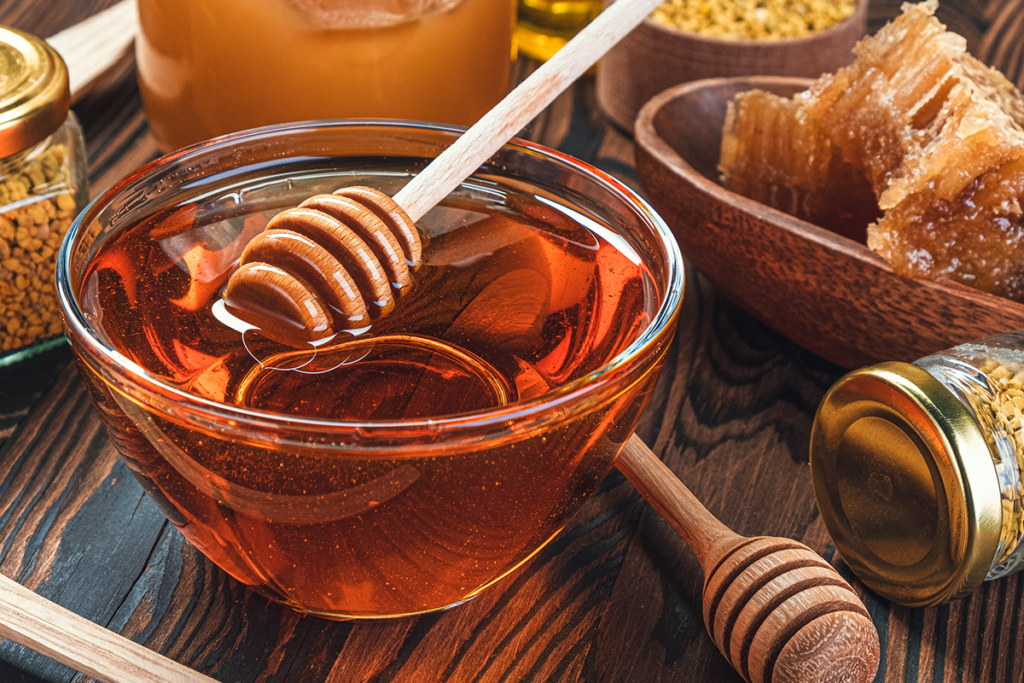
In fresh fruit, sugars, acids, water, fibre and colour compounds are found within plant cells. In seeds, cell walls enclose some components. In dairy foods, proteins, fats, water and minerals form a particular structure. Honey, meanwhile, is a concentrated mixture of sugars, water, organic acids, aromatic substances and small amounts of other naturally occurring compounds.
In each food, individual components sit in a particular environment. They may be dissolved, bound to other molecules, enclosed within cells or dispersed in an emulsion.
For consumers, the key point is that two servings with similar amounts of one nutrient are not necessarily identical. How quickly that nutrient is released and how available it becomes during digestion can depend on the structure of the whole food.
The ingredient list tells us what was used to make a product. The nutrition table shows amounts of energy, fat, carbohydrates, sugars, protein and salt. Neither describes every physical and chemical interaction.
Imagine two products with the same amount of fat. In one, the fat may occur as larger droplets surrounded by natural membranes. In the other, intensive processing may have dispersed it evenly. Their numerical composition may look similar, while the two structures need not be digested in exactly the same way.
The same applies to plant foods. Chopping, cooking, juicing and removing some fibre change their structure, even when some basic constituents remain.
That is why nutrition science increasingly asks not only, “How much of a compound does this product contain?” but also, “In what form and environment does it occur?”
Articles about food use several terms as if they were interchangeable, although they describe different stages.
Content is the amount of a component measured in a sample. Its presence alone does not tell us how much will be released during digestion.
Bioaccessibility is the portion released from the food matrix in the digestive tract and potentially available for absorption.
Bioavailability concerns the amount actually absorbed, metabolised and made available to the body.
Bioactivity describes a compound’s potential to affect a biological process under the conditions studied.
Detecting a substance in a product therefore does not mean it will all reach the blood or tissues. Some may be broken down, bind to other parts of the meal, be transformed by the microbiota or be excreted.
This is one reason why judging a food solely by a number of milligrams can lead to conclusions that go too far.
Digestion begins in the mouth. Chewing increases the surface area available to enzymes, while saliva moistens the food and starts to change its structure.
In the stomach, food meets an acidic environment and enzymes. Proteins may change shape, and muscular movements mix the contents. Pancreatic enzymes and bile then join the process in the small intestine.
As digestion proceeds, the original matrix gradually breaks apart. Components are released, dissolved or incorporated into new structures that help transport them. Some compounds may reach the large intestine, where gut microorganisms can act on them.
The process is far more complicated than dissolving a tablet in a glass of water. Components interact, and the result also depends on other foods eaten in the same meal.
Components of one food can increase or limit one another’s availability. That is not always good or bad; it is simply part of the chemistry of digestion.
Fat in a meal can take part in the release and transport of fat soluble substances. Fibre can slow stomach emptying while also binding some compounds. Organic acids can alter the chemical environment in which digestion occurs.
Some substances form complexes. Others compete for similar transport mechanisms. Still others are converted into new molecules by enzymes or the microbiota.
That is why a natural ingredient matrix should not be presented as a magical “synergy” that always makes a product more valuable. Interactions can work in several directions. Their importance needs to be tested for the specific product, dose and way it is consumed.
There is no one word answer.
An isolated ingredient has the advantage of a precisely defined dose. In laboratory and clinical studies, this makes it easier to investigate how amount relates to effect. A substance can also be formulated to improve stability or allow a particular method of use.
A natural product, on the other hand, contains many components in a characteristic arrangement. Some may affect the solubility, taste, shelf life or release of others.
That does not mean a complex mixture automatically works more strongly or better. It may contain only small amounts of individual substances. Its composition can vary between batches, and some elements may limit the availability of others.
The useful question is therefore not “Which is always better?” but “Which product, at what amount, for what purpose and on the basis of which data is being assessed?”
Honey consists mainly of sugars and water. It also contains organic acids, aromatic substances, enzymes derived in part from bee activity, minerals and small quantities of compounds that depend on its botanical origin.
The proportions can vary with the plants visited by bees, seasonal conditions and the handling of the raw material.
Honey can therefore be considered a natural matrix. That alone does not justify attributing any particular health benefit to it. A description of complex composition characterises the product; it does not prove a therapeutic effect.
Honey is also a source of sugars. It should be considered in the context of the overall diet, especially by people who need to monitor their sugar intake.
Propolis is made from resinous materials that bees collect from plants and process in the hive. Its profile depends on the local flora, region, harvest time and preparation method.
The word “propolis” may therefore refer to raw materials with different proportions of waxes, resins and plant derived compounds.
The extraction method adds another source of variation. A water extract may contain a different set of substances from an alcohol extract. Temperature, processing time and the ratio of raw material to solvent also matter.
Findings about one carefully characterised extract should not automatically be applied to every propolis product. This is especially important in messages aimed at consumers.
Food processing is not one uniform phenomenon. It ranges from simple actions, such as cutting or drying, to complex technological processes.
Grinding may increase the surface exposed to enzymes. Heating can soften structures but also alter heat sensitive compounds. Drying reduces water content, while fermentation brings about changes caused by microorganisms.
The outcome depends on the food and the processing conditions. It is not accurate to say that every form of processing is harmful or that a “raw” product is always superior.
Technology can improve safety, stability, convenience and consistency. It may also change flavour, structure or the amount of certain components.
A reliable product description should therefore consider both the origin of the raw material and how it was prepared.
Natural products can differ between batches. Region, season, weather, raw material and technology all play a part.
Standardisation means controlling selected parameters so that successive batches fall within specified ranges. It may cover the content of a particular compound, moisture, microbiological quality, chemical profile or other properties.
It does not make a natural product less complex.
Defenietley it does help describe more precisely what is in the finished form and whether production is repeatable.
Standardisation is particularly important in research. Without it, it can be difficult to tell whether two teams are studying comparable material.
Terms such as “synergy”, “comprehensive action” or “the whole is greater than the sum of its parts” can sound appealing. They are not always backed by measurements.
To investigate a matrix effect, researchers can compare:
Only such comparisons can help determine whether other components changed the stability, release or availability of a given substance.
Results from in vitro studies are still different from results in humans. Simulated digestion can provide valuable information, but it does not reproduce every difference in microbiota, metabolism or individual health.
“Full spectrum” often appears in descriptions of natural products. It has no single universal meaning.
Consumers should check whether the producer explains:
The phrase alone says nothing about effectiveness, bioavailability or superiority over other forms of the product.
The more specific and verifiable the description, the easier it is to distinguish technological facts from promotional language.
A brand blog can use the idea of a matrix to explain the complexity of bee derived raw materials. It should not suggest that the mere presence of numerous natural components proves a particular health effect.
A careful mention can be limited to facts such as the type of raw material used, the product form, quality control and the information on the label.
By contrast, it would be risky to claim that a natural mixture:
Conclusions about a specific product need to come from suitable data. Health claims about foods are also subject to separate rules.
It helps to balance an appreciation of nature with an overly narrow view of food as a collection of isolated substances.
A natural product may have an interesting origin, composition and characteristic structure. That does not mean everything natural is safe for everyone or has medicinal effects.
When reading a description, ask a few questions. Does the producer identify the raw material precisely? Are directions for use provided? Are there warnings? Does the text distinguish laboratory findings from human studies? Does it avoid assigning the product properties associated with medicines?
These questions support informed choices without giving in to exaggerated promises or assuming that natural composition has no relevance at all.
The natural ingredient matrix is the physical and chemical environment in which individual substances occur in food. It can affect their stability, release during digestion and interactions.
It does not mean that a natural product is always better than an isolated ingredient. The matrix concept cannot be used by itself as proof of a health effect either.
With honey, propolis and other natural raw materials, origin, composition, processing method, finished product form and batch consistency all matter.
The natural ingredient matrix helps explain why a list of substances alone does not describe the whole product. It is a starting point for further research, not a ready made conclusion about effectiveness.
The most responsible communication combines curiosity about nature’s complexity with precision. It describes what is known, separates hypotheses from findings and makes no promises beyond the available data.
This article is for educational purposes. It is not nutritional or medical advice and does not assess the effects of any specific product.