
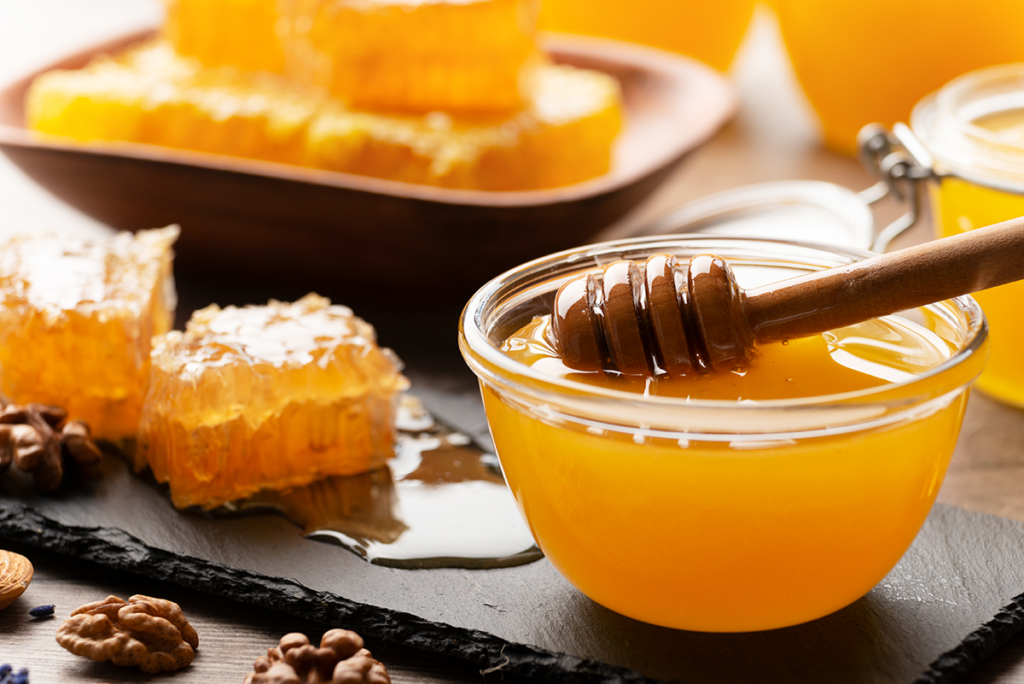
Georgian honey for immunity is gaining increasing attention thanks to its exceptional chemical composition. Unlike many European varieties, honey collected in the mountainous regions of the Caucasus contains significantly higher concentrations of aldehydes, phenols and ketones. These bioactive compounds are responsible for stronger anti-inflammatory, antioxidant and immune-supporting effects.
The region is characterized by enormous biodiversity – more than 1600 species of nectar-producing plants grow in the clean high-mountain environment. The absence of intensive agriculture and industrial pollution means that the nectar is rich in plant secondary metabolites.
In addition, specific climatic conditions (large temperature amplitudes, high humidity and strong sunlight) promote the accumulation of these compounds in honey.
Georgian honey for immunity contains several important groups of compounds:
Recent laboratory studies show that extracts from such honeys inhibit respiratory virus replication more effectively than standard honey varieties.
The unique compounds of Georgian honey act on several levels. Phenols neutralize free radicals, protecting immune cells from damage. Aldehydes, in turn, can damage pathogen membranes.
Ketones also support the proliferation of lymphocytes and macrophages. As a result, the body can recognize and eliminate threats more efficiently.
For example, in vitro models have shown an increase in macrophage activity of up to 30–50% after exposure to such extracts.
Compared with manuka honey (mainly methylglyoxal) or linden honey, Georgian varieties offer a broader spectrum of activity. Instead of focusing on a single compound, the synergy of aldehydes, phenols and ketones provides multi-directional effects: antibacterial, antiviral and anti-inflammatory.
For this reason, laboratory and clinical studies often show excellent results when these honeys are evaluated for immune support.
The simplest method is consuming 1–2 teaspoons daily – in the morning on an empty stomach or in warm water in the evening.
It can also be added to herbal teas such as:
In concentrated form (for example Camelyn preparations based on Georgian extracts available at www.camelyn.eu) the dose of bioactive compounds is higher, which makes regular use easier.
Additional ideas:
Georgian honey is safe for most people. However, individuals allergic to bee products should exercise caution.
Children under 1 year of age should not consume raw honey due to the risk of botulism.
Always choose honey from trusted and certified apiaries.
Georgian honey for immunity is a natural source of unique compounds that support the body in its daily fight against pathogens. Thanks to its high concentration of aldehydes, phenols and ketones, it stands out among other honey varieties.